Inside Pastor He's "Expository Sermon Outline"Version 1
Contents16 parts
- 0The three movements: burden → drive → shaking, plus evaluation
- 1Burden · Message theme
- 2Scripture
- 3Drive · Speaker · Date
- 4Occasion / Audience / Goal
- 5Sermon title
- 6Introduction
- 7Theme sentence
- 8Body · Sections and outline
- 9Illustration column (right column)
- 10Conclusion
- 11Shaking
- 12Evaluation
- AThe teacher's two sample slides
- BPsalm 23 sermon outline · Joseph
- CThe teacher's word pictures
Study notes from Pastor He's preaching class "Preaching the Lord's Word" (October–November 2026), put together from the recordings of three classes on 10/18, 11/1 and 11/8. Going down the sermon outline form from top to bottom, each box gives the teacher's definition (words in quotation marks are the teacher's own), best practices and cases from class. At the end are the teacher's two sample slides and a complete sample sermon outline on Psalm 23.
Red words = the theme (the teacher also marks the theme in red on the slides)✓ Cases the teacher affirmed✗ Problems the teacher pointed out
0The three movements: burden → drive → shaking, plus evaluation
The whole sermon outline form is designed in this order
The burden is the foundation. The drive is not the goal. The shaking is the goal.
"You have to have a burden. It's not taking some verses and patching them together."
"Drive means you have to turn this burden into a life, and then your life goes and inspires other people."
"Preaching isn't about how well someone speaks. Preaching isn't someone's performance. The goal of preaching is to shake people." (Heb 12:25–29)
Receive the truth→Witness with your life→Walk the path
Best practices
- When you prepare the message, ask first: when I'm done, what will shake the listeners? If you can't think of anything, this sermon is no use.
- The steps of the course: read the Bible or receive a word → find a principle that runs through the whole Bible → Scripture outline → sermon outline → full sermon → short sermon → self-evaluation.
1Burden · Message theme
First box of the form: Burden: Message Theme
The burden is what God has given you to receive. The theme is a few words, and it must appear in every outline point. The burden is not the same as the theme.
"The theme is a few words, not a sentence, and it runs through all your outline points."
"If your first section has it, and the second doesn't, and the third doesn't, then that's not the theme."
"It's very hard to preach two themes… so you must have one theme, and its basis must come from the Scripture."
"One passage can have several themes… but your sermon can only have one theme."
Best practices
- Write down the burden first, then look at your three outline points: which few words are in every section? That's the theme.
- Mark the theme in red on every line, so you can check at a glance that it runs all the way through.
- It's best to use the same word. If there's no shared word, there must at least be the same idea (for example, using He / you / I to express "relationship").
Cases
- Theme: differentThe teacher · Psalm 1Eternal life is different, this life is different, how it's different: all three sections have it, and so do the theme sentence and the conclusion.
- Theme: Good ShepherdThe teacher, reworking Student A'sThe Good Shepherd in good times, the Good Shepherd in hard times, the Good Shepherd for a lifetime.
- Theme: good friend (not "relationship")Student BA good friend in good times, a good friend in hard times, a good friend for a lifetime.
- Theme: I have someone behind me (not "knowing who God is")Student CHer outline points are my shepherd, my friend, my heavenly Father. The theme was really already in the outline.
- Taking the burden as the theme: "Following the Good Shepherd all my life"Student D"That's the burden you had at the start." His outline points are You lead me / You walk with me / I follow You, and the theme is you and me.
- Two themes mixed together: "not wanting" and "He and I"Student EThe first point didn't talk about not wanting, but all three points talked about He and I. "These are two different themes… please pick one."
2Scripture
Right box of the first row: Scripture
The basis of the theme must come from the Scripture. Meditate first, then study.
"You meditate, and as you meditate God will give you an angle. Then the next thing is we study. The purpose of studying is… to see whether it matches the direction I got in meditation."
"If it happens once, twice, three times in history, two or three witnesses show that it… is God's principle."
Best practices
- Pick one complete passage as the main text. Put other passages in the illustration column as support.
- If there's only one passage, you can't teach it as truth. Use Bible software to find two or three witnesses; then it's a principle.
Cases
- "Fearing the LORD = walking in his ways"The teacher · Psalm 128He proved it from several witnesses, Abraham, Noah and Cornelius (positive) and Jonah (negative). Only then does it become a principle you can teach.
3Drive · Speaker · Date
Drive: Speaker Date
The one who drives it is you: the truth changes you first, and then your life goes and inspires others.
"And you have to know who's doing the driving here. It's you, of course."
Best practices
- Write your own name and the date.
- Before you preach, ask yourself: how has this truth changed me? The answer is your testimony.
4Occasion / Audience / Goal
Occasion/Audience/Goal
When the occasion and the audience are different, the needs are different, and the goal is different. Writing it down helps you think it through.
"I see a lot of speakers preach the same sermon on different occasions. Then I know they don't get it."
Occasion: a holiday, a birthday, a church building dedication… Audience: adults, teenagers, people who don't believe yet.
Best practices
- Write one line for each item.
- For the goal, write "how the listeners will change," not "what I'm going to say."
- The audience decides the theme and the tone.
Cases
- Audience: teenagers → theme "good friend," lively toneStudent BThe teacher: "Your tone and your words just now were really great. That's exactly how to make them connect."
5Sermon title
Right box: Sermon Title
The sermon title draws people in and concerns every listener. The sermon title is not the same as the theme.
"The sermon title uses a title to draw people in, so they want to know, but don't quite know yet."
"Your sermon title matters a lot. It should make every person feel it has to do with them."
Best practices
- Short. A question or a picture is best.
- Check: is every listener in it?
- You can prepare two sermon titles as options (the teacher's slides both have two).
Cases
- Life or Death in a Single Thought / The Life-and-Death DivideThe teacher · Psalm 1Short and strong. Everyone faces life and death.
- How to Parent Teenagers → Being Grandparents / Parents of TeenagersThe teacher's revision"This title of yours takes in everybody."
- I've Got Someone Behind Me!The teacher's example for Student C"You can be very flexible."
- Where Does Peace Come From?Joseph · Psalm 23Everyone wants peace, and all three sections of the sermon answer this question.
- Paul's Faith / Peter's TemptationThe teacher's counterexample"This sermon title is a failing title, because then it has nothing to do with me."
6Introduction
Left column: Introduction, with the illustration written in the right column at the same time
The introduction brings the listeners into the theme and lands on the theme sentence at the end.
A standard sermon outline has three parts: introduction, body, conclusion. A testimony also has three parts: before, then, after.
Best practices
- Short. Start from the listeners' need, or make a catchy line out of the theme word.
- End with the theme sentence.
Cases
- With the relationship, no problem; without the relationship, big problem!The teacher · Psalm 23A play on the theme word that sticks the moment you hear it.
- "I have a good friend… he can even fight monsters, he knows everything… do you want to come and listen?"Student B · teenagersThe teacher: "Actually, your introduction is really good."
7Theme sentence
Full row: Theme Sentence
Turn the theme into one complete sentence in spoken language, and announce it to the congregation at the start. Give only the theme, not the content.
"A theme sentence always has a subject, a verb and an object, so it's a complete sentence."
"The theme sentence tells the whole congregation the theme, so everyone has an understanding and something to look forward to."
"The theme sentence is just one sentence that tells you the theme. It doesn't give the content."
The theme sentence doesn't have to use a verse. The theme sentence is also an announcement, a preview.
Best practices
- Formula: theme + result, first person, ending with "!".
- If the sentence already lists the content of the three sections, it's a conclusion, not a theme sentence.
- Why one sentence: "If I use twenty sentences, people probably won't remember them. One sentence, and everyone gets it."
Cases
- One thing different brings the life-and-death divide, in this life and in eternal life!The teacher · Psalm 1It leaves a question hanging: what is the "one thing"? The conclusion reveals it.
- A close relationship with the Lord makes me blessed forever!The teacher · Psalm 23Theme + result.
- I have a Good Shepherd, so all my life I shall not want.The teacher, for Student AShort, first person, theme only.
- All my life, because I have someone behind me, I'm not afraid of anything.The teacher, for Student CThe same formula.
- I have a good friend, so I'm not afraid of anything. Do you want to know him?The teacher, for Student BFor teenagers, add a question that invites them.
- I have true peace, so I'm not afraid of any storm!Joseph · Psalm 23Fits the teacher's formula exactly.
- "In easy circumstances and in hard circumstances, he is my Good Shepherd"Student A"This sentence is more like your conclusion": it already gives the content.
- "We must believe the LORD"Student GIt doesn't preview "believe whom? believe how?". The teacher changed it to: "We must believe the LORD, and my life will be different."
8Body · Sections and outline
Full row: Body, with the outline and verses written in the left column below
Each section is one complete unit of thought. One sentence that sums up the section is the outline point. The theme runs through every outline point.
"A section is a unit of thought, so it has to be a complete unit of thought."
"We sum up this section in one sentence, and that's called the outline point."
"You have to find the Bible's own structure of thought, not divide it up for it myself."
"In expository preaching the Bible leads, and I find the Bible's thought. In topical preaching my thought leads, and the Bible is material I use."
Best practices
- First find the passage's own structure: parallel lines, contrasts, pronouns.
- 3 main points × 2 sub-points. Use the same sentence pattern and the same number of words at each level. Mark the verses on every line.
- Give each section a fair share of the passage. Avoid "small head, small feet, big belly."
- You can rearrange the order and put the most central point last.
- The Scripture outline isn't always the sermon outline: depending on the occasion and the audience, pick one of the passage's several themes.
Cases
- A Eternal life is different → B This life is different → C How it's differentThe teacher · Psalm 1Works back from result to cause and ends with the most central thing, "thinking." The sub-points contrast in pairs: the righteous / the wicked.
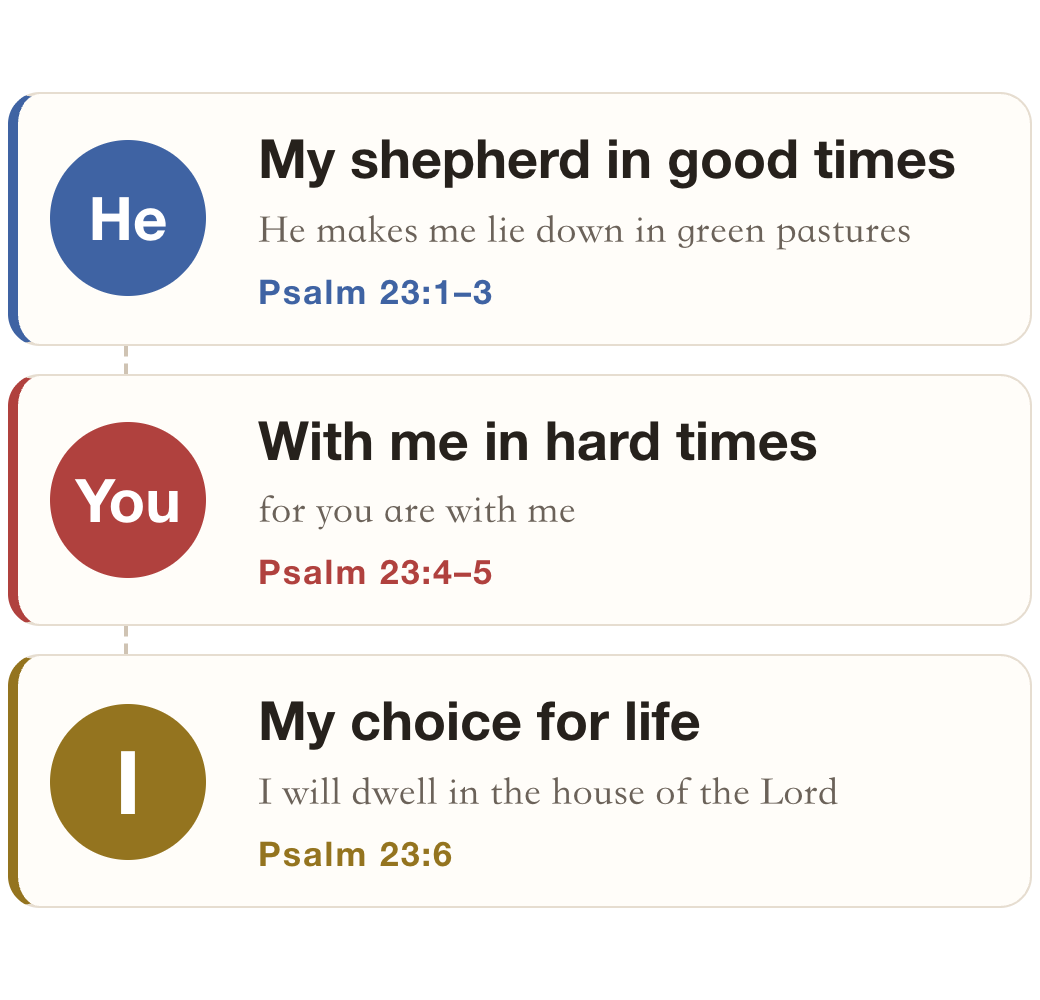
- A He shepherds in good times → B You are with me in hard times → C I will dwell all my lifeThe teacher · Psalm 23Divides the sections by the passage's own pronouns, He → you → I. Every sub-point starts with the same pronoun.
- Found the framework, didn't go verse by verseStudent F · Psalm 1The teacher affirmed that he had found the passage's structure.
- Verse-by-verse style: 8 points from the 6 verses of Psalm 1The teacher's counterexample"When he's done, do you remember his eight points? The answer is, there's no way you'll remember them."
- Sections of 1 verse / 4 verses / 1 verseStudent G"Small head, small feet, big belly": you'll spend too much time in the middle.
9Illustration column (right column)
Right column: Illustration
In the left column, write the verses you cite and the explanation. In the right column, write the illustrations and applications. Make a point, then give an example right away.
"You say it, and right away there's an example. You say it, and right away there's an example."
"At a glance I can see whether this part has too many stories and that part has no illustration."
Best practices
- At least one illustration and one application for each section.
- An illustration can be another passage or a testimony. Your own testimony is the strongest.
- Bones first, then meat: "Without bones, a pile of meat is no use."
Cases
- Put a testimony under every outline pointStudent BThe teacher: "I see you have testimonies under your outline points. Very good."
10Conclusion
Full row: Conclusion
The conclusion answers the theme sentence and covers the main content of each section, closing the loop.
"In the conclusion, you answer your own theme sentence."
"At the start you tell the congregation what you're preaching today, and at the end the conclusion says you really did preach that."
"So it's closed-loop, complete language… it makes sure your thinking is one line."
Surf and turf: the theme sentence announces "today we're having surf and turf"; after the meal, the conclusion asks "is everyone satisfied?"
Best practices
- Repeat the key words of the theme sentence ("truly…").
- Put the content of the three sections, in order, into one sentence.
- Use a question to lead into the shaking ("Have you…?").
- If the theme sentence changes, the conclusion has to change with it.
Cases
- Your different "thinking" brings the life-and-death divide!The teacher · Psalm 1Reveals that the "one thing" in the theme sentence is "thinking," and repeats "the life-and-death divide."
- A relationship that longs for God's presence makes me blessed in good times and hard times!The teacher · Psalm 23Repeats "relationship… blessed" and adds the outline's good times and hard times.
- In good times I have a good friend, in hard times I have a good friend, all my life I have a good friend. Do you have a good friend?The teacher, for Student B"This is your conclusion, and it brings out the challenge that follows."
- By believing in the declaration, believing in experience, believing in relationship, my life truly is different.The teacher, for Student G"Truly" answers the theme sentence "my life will be different."
- "Know Jesus, and let him become our good friend"Student B's first versionIt didn't answer her theme sentence, and it didn't cover the three sections.
11Shaking
Shaking: Small-Group Sharing, Prayer and Declaration, Life Practice
The goal of God speaking is shaking: removing what can be shaken, so that what cannot be shaken may remain (Heb 12:25–29).
"If I finish preaching and they haven't been shaken, my sermon is no use at all."
"If they can't remember it, it can't shake them."
Best practices
- Small-group sharing: split into groups for discussion right after the sermon (the first kind of active learning).
- Prayer and declaration: pray what you received into your own life and daily living.
- Life practice: remind each other afterwards, for example a small group reminding each other every day to meditate on the Lord's word.
Cases
- Nathan said to David, "Thou art the man."2 Sam 12The teacher's example of shaking.
- John the Baptist: "O generation of vipers"Matt 3Being baptized doesn't mean all is well. The heart must be circumcised, and the life must change.
- Three discussion questions + praying to receive a brave heartStudent DAfter meditating, what is your life following? Share the grace of the Good Shepherd. Where is the Holy Spirit showing you that you're afraid to follow? The teacher: "It went beyond what we asked or taught."
12Evaluation
Full row: Evaluation, written only after the short sermon
A 10-minute short sermon, 10 minutes of evaluation. Watch your own video and write a self-evaluation.
"The best teacher is you, watching yourself." (Touching your head, touching your face, saying "uh, uh": watch yourself and you'll know.)
Self-check list
- Does the theme appear in every section?
- Does the theme sentence only preview, without giving the content?
- Does the conclusion answer the theme sentence and cover every section?
- Does every section have an illustration and an application right away?
- Does the sermon title concern every listener?
- Were the listeners shaken?
- Timing, fidgeting, filler words.
AThe teacher's two sample slides
What they share: very few words, but every line is right
BPsalm 23 sermon outline · Joseph
Put together using the definitions above; Joseph revised the sermon title and theme sentence himself
Sermon titleWhere Does Peace Come From?
Themepeace
Theme sentenceI have true peace, so I'm not afraid of any storm!
IntroductionWhat is your peace built on? When circumstances change, that kind of peace is gone.
I. The source of peace: God leads first vv. 1–3 · John 14:27
II. Peace in the storm: trusting God's presence vv. 4–5 · Mark 4:35–41
III. Peace for a lifetime: following God all the way v. 6 · Josh 24:15
ConclusionWhere does peace come from? God leads me first, he is with me in the storm, and I follow him all my life. So I truly have true peace, and I'm not afraid of any storm! Do you have this true peace?
ShakingSmall group: What is your peace built on? · Prayer: Lord, help me see your leading, trust you in the storm, and be willing to follow you all my life. · Practice: Read Psalm 23 every day for a week.
| Check | Result |
|---|---|
| Is the theme in every section? | Yes: the source of peace / peace in the storm / peace for a lifetime |
| Does the theme sentence only preview? | Yes: theme + result, without listing the three sections |
| Does the conclusion answer the theme sentence? | Yes: "truly have true peace, and I'm not afraid of any storm" echoes it word for word; the middle sentence covers the three sections; the opening answers the sermon title |
| Do the sections follow the passage's structure? | Yes: verses 1–3 speak of "he," verses 4–5 speak to "you," verse 6 is "I" |
| Still to add | Speaker, date, two of my own testimonies; the evaluation is written after the short sermon |
CThe teacher's word pictures
| Picture | Meaning |
|---|---|
| Ice skating with your feet going two ways | Two themes, and you're sure to fall. |
| Surf and turf | The theme sentence is the preview; the conclusion asks, "Satisfied?" |
| Crumbs on the table | When the speaker isn't clear, the listeners only pick up a story and miss the feast of the central theme. |
| No bones, just a pile of meat | Without an outline, the details and illustrations are no use. |
| A martial arts master | Revise the same sermon outline dozens, even hundreds of times, and only then is every word a gem. |
Sources: recordings of Pastor He's three classes in 2026 on 10/18 (Lecture 1 · the three movements), 11/1 (the sermon outline template) and 11/8 (sermon outline practice), and the teacher's two sample slides. Classmates are referred to as Student A–G.
You might also like
Hard Times Bring Us Closer to God
One day I was meditating on Psalm 23, and a picture seemed to come bef…
The Roots of a Life Determine Its Direction
Psalm 1: from a renewed mind to the fruit of a life. This psalm shows…
I love him so much. Why isn't it enough?
That night, dinner was ready and 高明 was still playing video games. His…
In the AI Era, Our Children Will Leave Us: Three Things Parents Must Really Leave Them
One day you'll suddenly realize: your child doesn't need you as much a…
From Knowing to Doing: Four Reconciliations for Growing in Life
We've taken so many courses and learned all kinds of theories. We know…
Your House Is on Fire. What Do You Save?
Jewish parents often ask their children a question: "If one day the ho…