More Important Than Grades Is What Grows Inside Your Child
Parenting in the Age of AI · Lesson 5 of 8In this series
- 1In the AI Era, Our Children Will Leave Us: Three Things Parents Must Really Leave Them✓
- 2When Kids Are Hooked on Their Phones, What Should Parents Really Be Tending?✓
- 3When Your Child Starts Telling AI What's on Their Heart, Instead of Telling You✓
- 4You Think You Love Your Child So Much✓
- 5More Important Than Grades Is What Grows Inside Your Child✓
- 6When AI Can Answer Anything, We Need Even More to Teach Our Kids to Ask: "Why Am I Choosing This?"Out Nov 13
- 8It's Not That Kids Won't Listen. It's That Fewer and Fewer People Really Listen to ThemOut Nov 14
- 9Why don't our kids always live out all the things we teach them?Out Nov 15
"Mom, why do I still have to learn this? AI can already do it."
Today, that's no longer just a kid joking around.
AI can write essays, solve math problems, translate languages, make pictures, and even put together a beautiful report in a few seconds. Some of the skills we spent years training our kids to master, machines are learning faster and faster.
So a very important question sits in front of us as parents:
If one day AI can calculate faster, write faster and know more than our kids, what exactly are we still supposed to teach them?
I think the answer may be taking us back to the oldest, and the most important, question in education:
The goal of education isn't only to help a child "be able to do things." It's to help them become "a certain kind of person."
1. The smarter AI gets, the more character matters
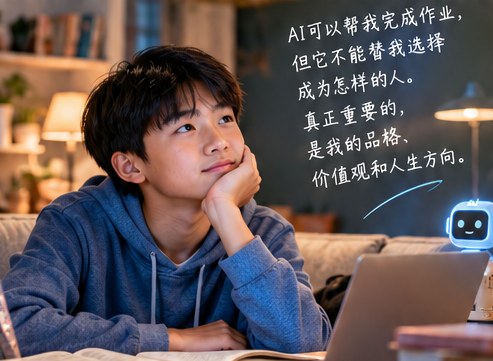
In the past, parents often put the focus of education on a child's abilities.
How are the grades? Is their English good? Are they strong in math? Can they get into a good university? Will they be competitive someday?
Of course these things matter.
But AI is changing what "ability" is worth.
If a child can't write a certain kind of essay, AI can help. If they can't make a PowerPoint, AI can help. If they don't know something, they can look it up in a few seconds.
But there are some things AI can't do for a child.
AI can tell a child what honesty is, but it can't choose between cheating and honesty for them.
AI can explain what responsibility means, but it can't carry the consequences when they do something wrong.
AI can write an apology letter, but it can't truly repent for them.
AI can generate an essay about love, but it can't go and love a difficult person for them.
So what may be truly scarce in the age of AI isn't just knowledge. It's honesty, responsibility, courage, self-control, empathy, patience, good judgment, and the ability to still choose the right thing when temptation comes.
In other words:
The more powerful AI becomes, the more we need to raise people who can use power rightly.
2. Have we quietly turned "grades" into our child's identity?
A recent study that followed teenagers over time gives parents a very interesting reminder.
The researchers followed more than 700 kids in their middle school years. They found that positive parenting was linked to stronger character strengths in children, and those character strengths were in turn linked to later performance in language arts and math.
A study like this can't simply prove that "building character will definitely raise grades." But it does remind us: character and learning aren't two separate worlds that have nothing to do with each other.
Think about it. What does a child need to keep learning over the long haul?
They need self-discipline to sit down even when they don't feel like studying. They need patience to face a math problem they can't solve. They need humility to admit, "I don't know how." They need courage to raise their hand and ask a question. They need a sense of responsibility to finish what they promised to do. They need honesty so that, when AI has already handed them the answer, they still ask themselves:
"Do I really know this?"
These things look like "character," but in fact they affect learning every single day.
And yet sometimes we get the order backwards.
Our child scores 98, and we're thrilled. Our child honestly admits a mistake, and we may only get angry.
Over time, a child slowly learns: grades matter more than honesty, results matter more than the process, and winning matters more than becoming a person of integrity.
Parents don't teach this on purpose. But children learn it from how we react.
3. Real character often grows where no one sees
I often feel that the best time to judge a child's character isn't when they're receiving an award.
It's this: during a test, when the teacher turns around, will they peek at the answers? When they lose on the field, how do they treat the ones who won? When a little brother or sister breaks their things, how do they respond? When a friend is being left out, do they dare to stand up? After they've done something wrong, do they make excuses or take responsibility?
And especially now, in the age of AI, there's a new question:
When a child knows that a few keystrokes will get them homework that looks excellent, what will they choose?
Parents can't always stand right beside them. Teachers can't check whether every answer was written by AI.
So what will really protect our kids in the future can't just be more monitoring. It has to be a voice inside them that, when no one is watching, still says:
"I could do this, but I'm choosing not to."
That's character.
Real education is slowly turning the rules outside a child into principles inside them.
4. Don't just praise "You're so smart." Start praising how your child chooses
So how do parents build character?
Actually, you don't necessarily need a "character education class." A lot of character is shaped by the things we say every day, one sentence at a time.
Your child comes home with a test marked 95. We naturally say, "That's amazing! You're so smart!"
Of course you can encourage them. But why not ask one more question: "What are you most pleased with yourself about this time?"
Maybe they'll say, "There was one problem I just couldn't get, but I didn't give up."
Then you can say, "Mom really admires how you stuck with it."
Your child loses a competition but goes over on their own to congratulate the other side. Tell them, "You didn't get first place today, but Mom saw that even after you lost, you still respected others. That makes me happier than a medal."
Your child breaks something and owns up to it. Don't scold right away. Tell them, "When something gets broken, we need to take responsibility. But you were willing to tell me the truth, and that's precious."
Slowly your child will come to know: what Mom and Dad see isn't just my grades.
They're also watching what kind of person I'm becoming.
5. Character isn't "told" by parents. It's "seen" by children
This is the hardest part.
We want our kids to be honest, but when the phone rings, we say, "Tell him Dad isn't home."
We ask our kids to control their phone use, but at dinner we parents keep replying to messages.
We tell our kids not to lose their temper, but when someone cuts in front of us while we're driving, we start yelling right away.
Children hear what we say, but they watch even more carefully how we live.
So the most important textbook for character education may not be a book. It may be the parents themselves.
Of course, this doesn't mean parents have to be perfect.
In fact, a parent who's willing to admit a mistake is already teaching their child a very precious kind of character.
A mom can say, "Mom was too impatient just now, and what I said hurt you. I'm sorry."
From that the child learns: grown-ups make mistakes too, but after a mistake you can take responsibility.
That may have more power than telling them ten times, "You need to learn to apologize."
6. Character education in a Christian family isn't just about raising "good kids"
For Christian parents, character has an even deeper meaning.
We don't just hope our kids will become polite, high-achieving "good kids" that everyone likes.
Even more, we long for the life of Christ to grow more and more inside them.
Galatians 5:22–23 says:
"But the fruit of the Spirit is love, joy, peace, longsuffering, gentleness, goodness, faith, meekness, temperance."
Think about it carefully: how well these qualities fit the age of AI.
When algorithms keep stirring up people's desires, we need self-control. When the internet rewards anger and attacks, we need gentleness. When everyone wants an answer right now, we need patience. When the virtual world makes people more and more self-centered, we need kindness. When AI can create content where you can't tell real from fake, we need honesty and faithfulness all the more.
So character education in a Christian family isn't just telling a child, "You should be a good person."
It's helping them slowly understand:
"Who do I belong to? And so, what kind of person will I become?"
7. Tonight, swap out one question at the dinner table
I'd like to give parents a very simple suggestion.
This week at dinner, ask one less time:
"What did you get on your test today?"
And ask instead:
"Was there something today that took a little courage, honesty, patience or kindness?"
Let your child talk. Then you parents talk too.
Dad can share, "Someone at work really made me angry today. I wanted to hit back right away, but then I decided to calm down first."
Mom can say, "Today I promised someone I'd do something. I was actually really tired, but because I'd promised, I still got it done."
Slowly your child will discover:
So character isn't just something Mom and Dad demand of me.
Mom and Dad are learning too.
And then the family is no longer just a place where "parents educate children." It becomes a place where the whole family grows together.
Closing: One day the report cards will be gone, but character will remain
Dear moms and dads,
One day your child's elementary school report cards will be thrown away. The university acceptance letter will become an old piece of paper. Even many of the skills we're proud of today may be replaced by new technology someday.
But some things will go a long way with our kids.
How they treat people weaker than themselves. Whether they're honest when money or gain is on the line. Whether they can get back up after failing. Whether they stay humble after succeeding. What they'll choose when no one is watching. Whether, once they have ability, they live only for themselves or are willing to bless others.
These things will eventually go into their marriage, their work and their friendships, and into the family they'll one day have.
So in the age of AI, maybe we need to redefine one sentence:
"My child is excellent."
Excellence isn't just how much they know, but how they use what they know. It isn't just how fast they can go, but whether they know why they set out. It isn't just how much money they'll make someday, but what kind of person they'll become once they have ability and resources.
AI can help our children become more capable.
But only life can shape life.
May it be that one day, when our children have left home, with no teacher watching and AI ready to do so many things for them at any moment, there's still a steady voice inside them:
I will be honest.
I will be responsible.
I will be kind.
I will have self-control.
I will choose what's right, even when no one sees.
Because what education leaves behind in the end isn't just how much knowledge a child holds in their hands. It's this: when knowledge, ability and freedom have all been placed in their hands—
what kind of person they have become.
——罗斌老师
AI can help children become more capable, but only life can shape life. The final question of education isn't just "What can my child do?" but "When no one is watching, what kind of person will they choose to be?"